Singapore Stamp Club 85 years of history
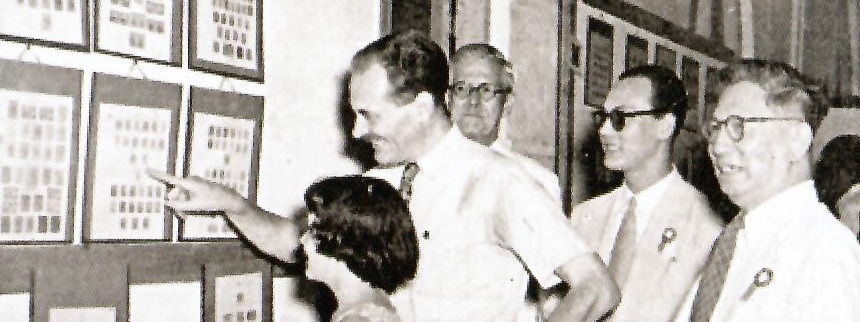
The Singapore Stamp club was founded in 1940 after the outbreak of war in Europe when many members found themselves in changed circumstances. Initially the activities were limited to stamp exchanges between members and to holding Charity Auctions in support of the War effort, but after the Fall of Singapore activities came to a halt.
The Club was revived immediately after the end of the war during a gathering organised in December 1945 at the then very fashionable G.H.Cafe. The first social meeting followed a week later at Ta Tong Restaurant. Henceforth, there would be fortnighly social meetings, often featuring an auction and sometimes also talks. An all-Malaya Exchange Circuit was started in 1947, resuming a pre-war practice. In the same year, the Club also started its outreach to school children. Starting from 1948 it organised philatelic competions during the August school holidays.
Club efforts to get school children involved in stamp design were rejected by the Colonial Office, but the need for more imaginative stamps was acknowledged, leading to the formation of Stamp Advisory Committee in 1949. One of its members was the Secretary of Economic Affairs who was no other than Mr. Andrew Gilmour, the founding President of the Club. The Stamp Advisory Committee remains active up until the present day.
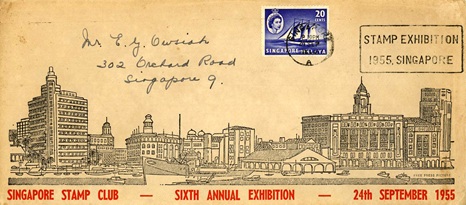
In the early years, meetings were held in facilities of the British Army or high end restaurants, but by the mid-50s the venue was shifted to the YMCA lest expensive restaurant tabs would deter member attendance. Meetings would be held there until well into the 1960s when the venue was changed to the Upper Lounge of the Singapore Cricket Club.
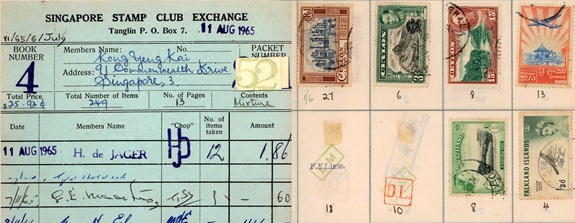
The Club organised annual exhibitions until 1958. With Singapore gaining internal self-government and later independence, the Club saw many of its members move overseas. Of the 103 members recorded for 1964, 22% were outside of Malaya. The Malayan members were split nearly equally between Malaysia and Singapore.
The Exchange Circuit catered to the Malayan members. Members would select stamps from approval books submitted by other members, and mark purchases with their personal chop. Administering the Circuit was the Exchange Manager who needed to ensure that packets circulated smoothly as well as handle the accounting and settlement of the sales based on purchase slips that members had to submit. With the PC and the spreadsheet yet to be invented, this was a labour intensive job as annual turnover ran into the tens of thousands of Dollars comprising of many small transactions of several dimes.
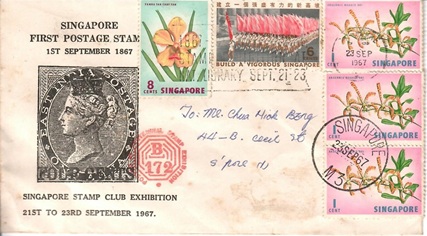
If in the early post-war years the complaint had been that Malayan stamps were dull in comparison to those of many other British colonies or dominions, after Self-government and later Independence, Singapore was at liberty to design her own stamps resulting in many series that further enhanced the appeal of collecting local stamps.
Building on this momentum, in 1967 the Club organised a special exhibition to celebrate the Centennial of Stamp Issuance in Singapore. This in turn stimulated collectors and the Club entered a period of rapidly growing membership, ending the decade with 346 members with the tally crossing 500 two years later.
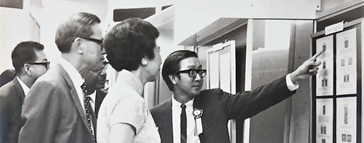
After Independence, the Postal Services Department (PSD) started taking a more active role in promoting stamp collecting. The Philatelic Bureau was opened in 1968, and starting with the 150th Anniversary Philatelic Exhibiton in 1969 it became the principal organiser of the Annual Exhibits, with the Club and the Singapore Philatelic Society as co-sponsors. In the years that the SPS did not hold an Exhibition (1972, 1977), the Club organised its own. These exhibits often included invited international exhibits as a way to expose local collectors to international exhibition practices.
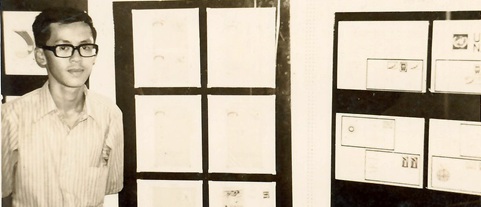
The Stamp Club continued to play a role in promoting junior collecting through its Junior section, and formally started admitting junior members effective 1970. Membership of the Club gave access to stamps, which starting from 1977 they would be allowed to buy direct rather than through the assistance of Senior Members. The more promising Junior members were taken under the wing of Seniors, who helped or encouraged them to research and publish or exhibit their collections. Thus then junior member Hong Tuck Kun worked with senior member Bill Lyons to publish a book on Singapore Registration Labels, later extending his scholarship to many more aspects of Singapore stamps, and serving as Journal Editor for many years. These efforts dovetailed with joint efforts by the PSD and the Ministry of Education to promote School Stamp Clubs.
The 1970s also saw strong growth in international competitive exhibitions. Club Chairman Koh Seow Chan and member Chan Huei Lock were among the founders of FIAP, FIP's Asian branch that was registered in 1974. This allowed Club members to participate in international exhibitions. The first club member to win a Grand Prix International Award was Mr. Tay Peng Hian who exhibited his collection of Straits Settlement from the pre-stamp period through 1899. Mr. Koh was the first Singaporean to earn a place on the Roll of Distinguished Philatelists, and he went on to win a Grand Prix National Award during the Canadian World Exhibition of 1996 for his collection on New Brunswick and Nova Scotia between 1851 and 1867.
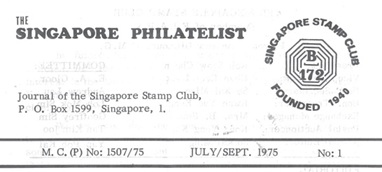
From its inception, Club members had not just been collecting, but also actively studying their collections, and sharing their knowledge in talks. Some were also members of the Malayan study group that was started by a US collector in 1959, and dedicated solely to the study of Malaya's postal history. Starting in 1955, the Club produced Monthly newsletters that in addition to Club news, contained articles by members and information about new stamp issues and other aspects of Singapore's postal services. It was later decided to dedicate a separate publication to record all aspects about Singapore's postal history, with the intention that it would become the go-to reference in times to come. Thus the Singapore Philatelist was born.
Throughout this period, the Club held monthly meetings on the second Tuesday evening of every month. These meetings often featured talks by members or invited guests such as a stamp designer, as well as a small room auction. As friendly social exchange with fellow collectors remained a key objective of these meetings, most of the actual exchanging of stamps took place off-site during postal auctions and through the Exchange Circuit. Sales of stamps among members totalled $54k in 1969, surpassing a previous record of $45k set in 1967.
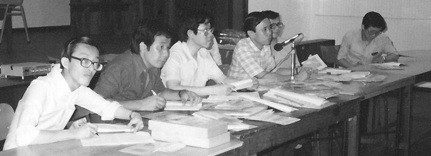
As the 1970s drew to a close big auctions were getting very popular and seeing record turnover. Varying its pattern of smaller postal auctions combined with room auctions during meetings, the Club organised a Jumbo Auction in Oct-79 that was a resounding success with turnover of $25k - easily 10-fold the result of its regular postal auctions. Singapore collectors were now also on the radar of international dealers who would organise pre-auction displays in Singapore for important Asian auctions held in Hong Kong or Japan.
With the start of the new decade, the Club celebrated its 40th anniversary. This was marked by holding a Stamp Fair that met with such good response that it first became a regular event. Initially the Fairs were held semi-annually, but after the very successful Philex Asia 87 exhibit at the New Otani Hotel, this became the venue of quarterly fairs for 18 years until 2005. Use of the Plum Room was free of charge provided at least 20 Club members attended the River Terrace Coffee House buffet lunch ($30/pax). Events ran from 10am to 5pm, usually with six to eight dealers that sometimes included international vendors. The regular Tuesday evening meeting continued to be held, supplemented in 1986 by Club house sessions on every second and fourth Sunday of the month where members could meet and exchange stamps in person. As membership was now mostly local, interest in the exchange circuit deminished resulting in its discontinuation. This also reflected a shift in collecting styles to also include postcards and covers that were better served by auctions. Thus the Jumbo Auction became an annual event, with the postal auction becoming part of the Quarterly Fair. During this decade membership numbers fluctuated around the 400 mark, but seeing a fair amount of turnover as older members, especially those overseas, resigned, and not all new members persisted.
Stamp collecting continued to evolve. The hobby profesionalised, as exhibiting collections now became an aspiration of many members. Monthly talks often featured reports on international exhibitions by the Commissioner in charge, as throughout the 1980s the Chairman as well as multiple committe members were active officers of FIAP. Members were also active participants in regional exhibitions, such as Bangkok 83, Ausipex, Philakorea 84, Stampex 86 and Thaipex 89 with upward of 10 (often different) members usually winning prizes.
Starting in the late 1970s, Singapore's postal services were modernised. Addresses were restructured, 4-digit postal codes introduced and sorting automated, Frama labels and new delivery services introduced. Along with regular new stamp issues and the ongoing opening of new post offices this contributed to a growing body of material of interest to Singapore philatelists. Many members actively pursued the study of the various aspects of this, yielding a rich crop of material for the Newsletter and the Philatelist.
The Club also continued its outreach to promote the hobby among the general public, with members holding talks in the Library or People's Associations, and engaging with junior collecting clubs or serving as judges in the various (inter) school exhibitions.
The 1980s were the decade in which the Postal Services Department corporatised in a multi-stage process. They now narrowed their outreach to promoting Youth philately, and ceased to initiate annual exhibitions. The Club, along with the Singapore Philatelic Society and other partners, stepped in to fill the void, organising Singpex 83, a one-week competitive exhibition of 427 frames. Three years later, these parties along with FIAP came together to organise Singpex 86/ASEANPEX 86. The 3rd Asian, Philex 87 held the following year, featuring 600 frames, the largest number seen so far.
The following decade, the Postal Authorities played an active role in stimulating junior collectors to exhibit. Working along FIAP and ASP, this resulted first in two Singpexes dedicated to Youth (and thematic) philately held in 1990 and 1991 in the lead up to Singapore 95, a World Exhibition that was to have an important Youth Section.
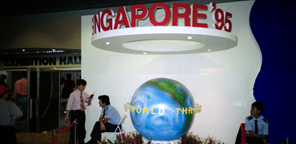
Singapore 95 was an event of national significance, as it would be the inaugural event held at the Singapore International Convention & Exhibition Centre (Suntec). Four years of intensive planning had preceded the event, involving annual Singpexes and an Asian International that were progressively larger to build up the logistical skills needed to hold a 10-day event featuring more than 3,000 frames.
For a brief period between 1973-4, the Club and 4 stamp dealers had jointly rented a shop in People's Park Complex that operated as a Stamp Centre. This had to close in 1975 due to rent increases. A whole decade was to pass before the Club could reopen its Club House when it gained use of premises at 121 Emerald Hill in 1986. Members could meet here every 2nd and 4th Sunday to swap stamps, use the libary and look at occasional exhibits. When access to these premises was lost a year later, the Clubhouse moved across the road to the function room of Top Ten Apartments in the same street that would serve as Club House through the end of 1993. In 1994 and 1995, the Singapore Philatelic Bureau hosted the Club house on its second floor, before finally the Philatelic Museum became the Club's home in 1996.
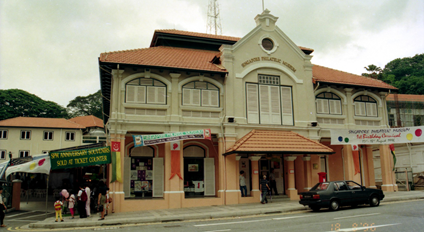
The Singapore Philatelic Museum (SPM) opened just before the start of Singapore 95. Designated as the body to promote interest in stamp collecting it offered meeting space to stamp clubs. This not in the least because Club members such as Lim Sa Bee had been closely involved in the planning of the musuem. Starting from Jan-96, it became the venue for both the Tuesday talks and the Sunday meetings.
The close ties with the SPM also gave an avenue for collectors to host exhbitions that fell outside of the boundaries of traditional exhibition classes. One example is the 1998 exhibition commemorating the Centennial of the issuance of the first post card in Singapore.
Energised by the success of Singapore 95, local collectors also put in a strong performanced during the International exhibitions that were held in China, Taiwan and Hong Kong in the following years. Prizes were won by number of Singaporean Youth collectors, while exhibitions by both Club stalwarts and newer collectors also earned multiple prizes. Much of this momentum was driven by former Club Chairman Mr. Koh Seow Chuan, who went on to head the ASP, and then served as FIP President from 2002-6.
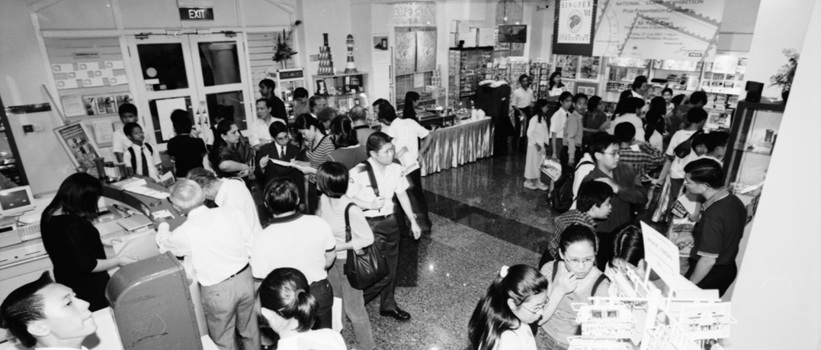
Singapore hosted the 12th Asian International in 1998, and then kept the momentum up with annual Singpexes that led the way to the 2004 World Stamp Championship.
Starting in 2006, the Quarterly Fairs were held at the SPM with the agreement that the Club would share half of its commission and (table)rental income with the Museum.
In the course of the noughties, as both mail and hobbies digitised, interest in stamp collecting waned. Official support for school stamp clubs waned in favour of promoting more IT-related hobbies such as robotics, with the SPM taking over the role of organising National Stamp Exhibitions with support from SingPost and ASP (Association of Singapore Philatelists). Raffles Institution, that had hosted Inter-School competitions going back to the late 1960s held its last Annual Youth Stamp Exhibition in 2005.
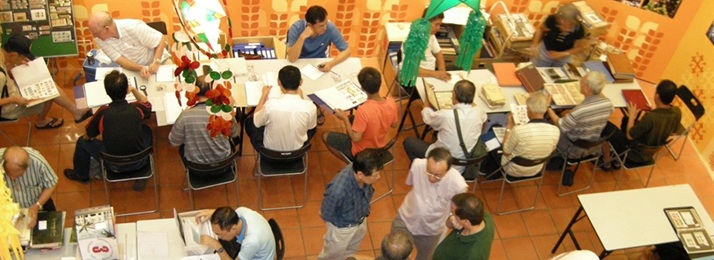
As a result of the declining interest in stamp collecting amoung the younger generation, aggregate club membership numbers declined. But a core group of Club members remained active in documenting and researching their fields as well as exhibiting.
The advent of the digital era opened new avenues to enjoy the hobby. Online market places and swap sites, increased availability of reference material allowed people to construct collections in ways that would have been unimaginable in an earlier era. The Club launched its own Facebook page, and so became visible to a new group of people.
Thus revitalised, the frequency of Singpexes again picked up after a lull in the late nougthies. In 2015, Singapore again hosted a World Exhibition, followed by an Asian International to celebrate its Bicentennial in 2019. Joint ASEAN exhibitions were also revived, with Singapore acting as hots in 2016 and 2022.
Over time, the SPM had increasingly focussed its activities on 'teaching children through stamps', leading to the decision to put child-engagement central. The last National Stamp Collecting Competition was held in 2019 whereafter the museum closed, reopening in 2022 as a dedicated Children's Museum. The Club held its last meeting at the Museum in Mar-2018, and thereafter until the start of Covid lockdowns in Feb-2020 would hold its meetings at The Substation in Armenian Street.
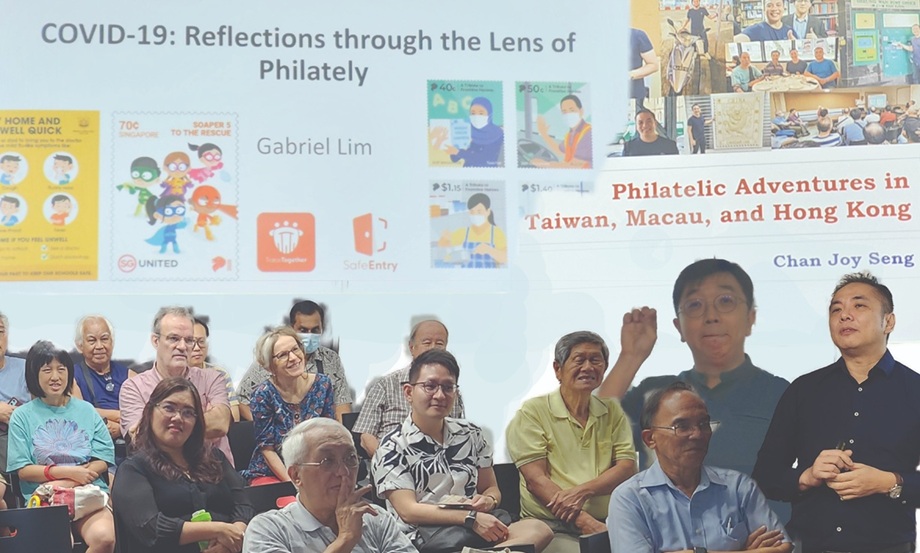
For slightly over 2 years during Covid, there were to be no meetings. Activities shifted online, with meetings held via Zoom and auction lots uploaded to the Club's Facebook page. In May-2022 the Club resumed in person meetings at Raja's Commercial College in Bras Basah Centre. In 2026 activities were further expanded with ad-hoc meetings on the 4th Sunday of the month in 'The Stamping Ground' a space provided by SingPost.
2024 saw the first post-Covid exhibition with Singapore hosting the Four Nations, followed two years later by a non-competitive SG60 exhibition to commemorate Singapore's 60th Anniversary. The free exhibition format gave rise to many interesting Singapore-themed exhibits, but it might well have been the event cachets that under influence of Japanese event-stamp collecting have become something of a social media hit.
It soon became evident that Covid had provided an impetus for people of all ages to re-engage with hobbies, resulting in increased Club meeting attendance after the lock-down. When the Club celebrated it 85th birthday it did so so with a reinvigorated membership body underlining the timeless relevance of the Club to bring together people over shared interests.